Two beers found in Hong Kong supermarkets, both lagers but very different. First up is simply titled 'Hong Kong Beer'.
Most beer actually brewed in Hong Kong is locally brewed under licence Europiss like Carlsberg or Heineken, or San Miguel from the Philippines (you can get both the locally made and original San Mig in supermarkets). This one is a happy exception though: it's 'hand-crafted', although presumably not literally.
It reminded me straight away of a Brewdog lager I had once; floral hops, although there was something subtly different about them from the bog-standard citrus hops you seem to get in every IPA. My Mother-in-Law said it tasted like soap, although that was because it's probably the first hoppy beer she's tasted. I'm sure we've all overheard a conversation in a pub when, faced with a round of drinks on the bar and unsure which is which, someone might try one at random and ask "errrr... did someone order pineapple juice???" when it's actually a citrus-hopped beer.
As is depressingly familiar though, to purchase this you have to go to a poncey foreigner-oriented supermarket; the local ones don't stock it, although there are a few bars around town that have it.
Next up: Mesquita from Cordoba in Spain.
To be honest I didn't know exactly how to approach this at first: I wasn't even sure if it was a lager or an ale. I had it straight out of the fridge, although the ABV strength of 7.2 and the dark pour suggested I might have been better off letting it sit for half an hour. It is a lager though, but unlike the Hong Kong Beer it was totally over to the malty end of the spectrum. When I taste a strong very malty lager I can't help thinking 'tramp juice' but this was far from it. Certainly one I'd look out for if I'm ever in Cordoba again (and if they actually sell it in Cordoba, of course. It wouldn't surprise me if you can't actually get it there.)
Friday, 22 February 2013
Saturday, 16 February 2013
Stoke via Hong Kong
Not the Stoke which produced Lemmy, or the Stoke who like to kick lumps out of the shins of persons wearing red and white outfits, but rather the Stoke brewed in Nelson, New Zealand by the McCashin family.
Beer in Hong Kong is unfortunately dominated by the evil Triad of Heineken, Carlsberg and San Miguel. If you cross their path, you may wake up to find a bag of decaying barley under your bedsheets (which they would have otherwise used to make their foul excuse for beer.)
But if you make an effort you can find decent beer without much trouble. Even in your bog standard supermarkets you can find some decent imported stuff like this: and at less than £1.30 or so a bottle you don't have to be Li Ka Shing or borrow from loan sharks to afford one.
They claim it's brewed with 14,000 year old water, and is made "the old fashioned way", with "bespoke" yeast, whatever that means. Despite that it's a very decent quaff, especially on a humid day. The 'gold' in particular has just the right floral / spicy side without getting in the way of things.
Friday, 1 February 2013
Estrella Damm Inedit
There are quite a few brewers of watery adjunct ridden pissy lager who, presumably to stop their brewers hanging themselves, will sometimes have a stab at making a decent beer. Thus we have Super Bock "gourmet", Peroni "gran reserva" and this fella, who grabbed my attention in El Corte Ingles.
It comes in a 75cl bottle with some poncey tags and stuff hanging off the top, like those jars of jam with hats on that you find at some posh shop in Devon. With wheat, barley and spices in the ingredients this promised to be another southern European brewer having a shot at a Witbier.
Spices in a Witbier should be like the icing on a cake, not the cake itself. Here, the spices were too prominent because there wasn't enough backing to them from the beer - altogether too lacking in any guts. Perhaps Estrella Damm should stick to lager.
Monday, 21 January 2013
Portuguese Craft
Porto is of course known mainly for Port wine, but if you look hard enough you can also find some craft beer, or Cerveja Artesanal as they say. "Sovina" is a beer brewed by Os Três Cervejeiros in small quantities and available at a fair few places around town, although it's not something you'd come across accidentally.
The entire range is unfiltered and includes an IPA, but when I popped round Mercearia das Flores they had just the witbier and the stout - the others had sold out.
It's got all the lemony zesty spicey type stuff you'd expect from a good witbier.
As for the stout: many stouts are bland. This one isn't by half. It's got an enormous burnt coffee taste that is a whisker short of being overpowering - the most interesting stout I've had in a long time.
Good show Sovina.
Thursday, 17 January 2013
Gourmet?...
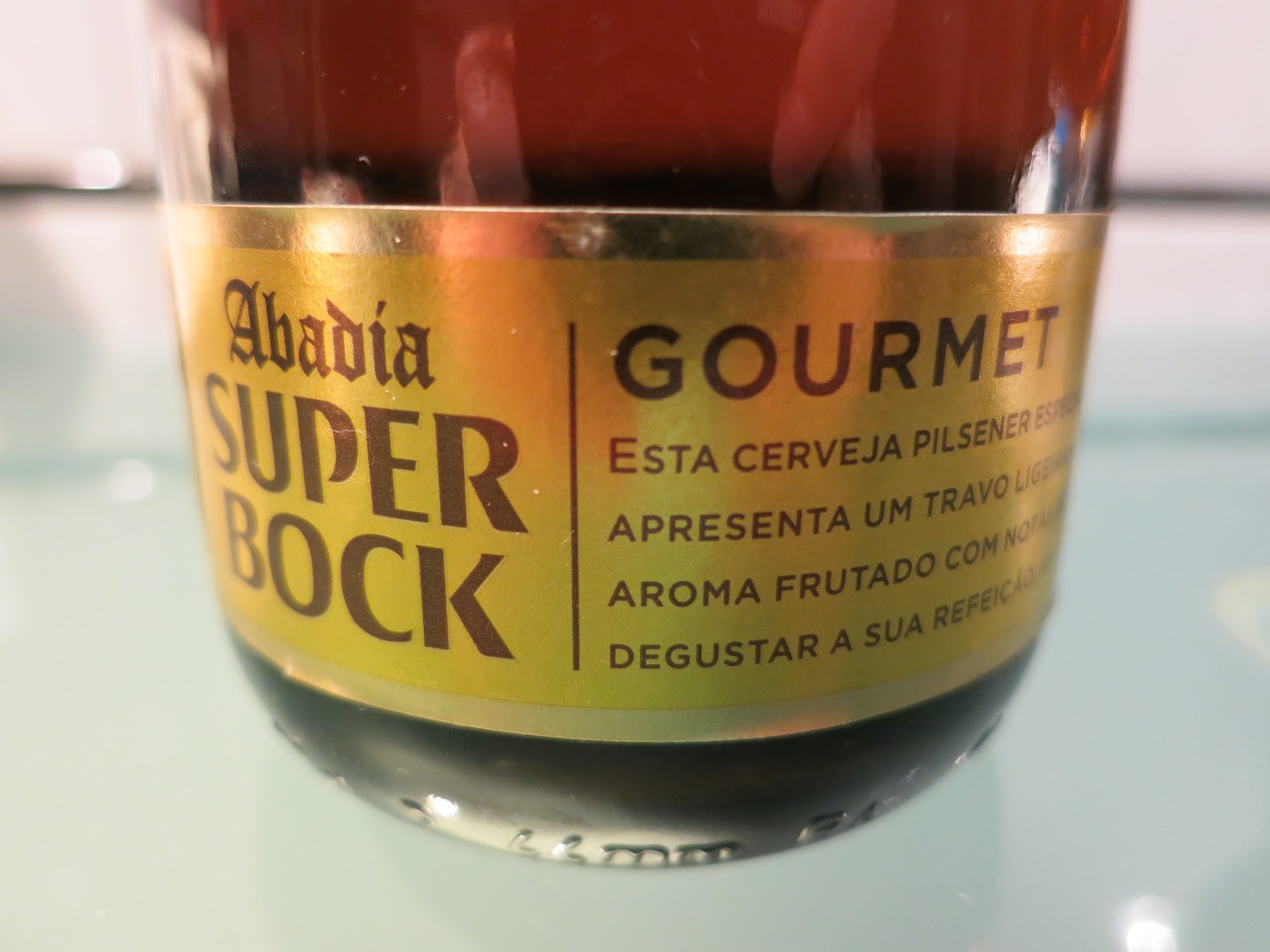
What do you do when your regular product is called "super" (even though it's not), but you want to have one product which is more "super" than the rest? Well, declare it "gourmet" of course.
"Super Bock" is a cruddy range of beers available all over Portugal, advertised with idiotic nonsensical English slogans, which in its regular form is your average adjunct filled lager. The "gourmet" version however boasts that it is 100% malt (presumably only gourmets don't want maize in their beer), and the "Abadia" denotes that it is supposedly imitating a Belgian abbey beer.
I was surprised by the colour, quite a fruity amber, and the decent head. There's definitely something in there, and compared to the piss that the rest of their beers are, I wouldn't mind making this a regular if I lived in Portugal. Buy it in a pack of 4 and it works out about 80 cents a bottle, so its price / taste ratio is not at all bad. They should drop the "abbey" claims though.
The thing is, you won't actually see it in a regular supermarket or booze shop - to get this, I had to go to El Corte Ingles, an upmarket Spanish shop, a bit like Galeria in Germany. So there you have it - piss tasting regular variety, available everywhere. Reasonable tasting variety, only 20 cents a bottle more, available hardly anywhere. Stands to reason really.
Tuesday, 8 January 2013
Portuguese Beer
The law of beer advertising states that the quality of a beer will be in inverse relationship to the amount that it is advertised. That's not to say that all beers that don't get advertised are good; rather that if a beer needs to be advertised it's probably crap.
After all, if your product is some revolting excuse for a lager that is bunged full of adjuncts and has a one day lagering time, it's not like people are going to drink it because it's any good. But sponsor some sporting event, bung it on TV every 30 seconds, maybe pay to get James Bond to drink it instead of Vodka Martinis, even drape it in a national flag, and people will be lining up to guzzle it with scarcely a care for that fact that it tastes like piss.
This law pretty much holds wherever you are. In Germany the few "national brands" that you see adverts for like Paulaner are renowned for being crap. Portugal isn't known for its beer, but there's a few home grown brews which pretty much reinforce the law.
"Super Bock" is advertised everywhere (there's probably a similar law for things that are sold as "super"), and comes in a number of varieties. Look on the ingredient list and it's adjunct city, predictably. This particular variety is called "Abadia" and lists sugar but no maize unlike the others. "Tagus" is another one that I encountered in a posh supermarket which I hadn't seen elsewhere, and seems to do without advertising - its label however proudly proclaims it to be an all-malt beer.
Any decent lager has an immediate crispness, and Tagus certainly does. It's nothing to get excited about, but is a perfectly pleasant drinkable brew with a lemony zest. "Super Bock" definitely lacks it - the contrast between the two is enormous. The bland, almost non-existent taste suggests that the budget went on advertising rather than lagering time.
There was also a Super Bock stout. It wasn't very interesting.
Sunday, 6 January 2013
Kreuzberger Molle
"Distinctive" is not a word that you can usually use when describing German beers. There is a distinct conformity clogging up the whole of German brewing, visible nowhere clearer than in German brewpubs. Almost without exception they will offer the same tedious triad of beers; in Bavaria it will nearly always be light lager, dark lager, and wheat beer, with some slight variation in different regions of Germany.
It's a relief then, to find the odd exception, such as Berlin's Brauhaus Südstern, which offers "special" beers including IPAs, brown ales and fruit beers.
One of its beers, an unfiltered lager, is available at Berlin's "Max & Moritz", one of those places described as an "institution", although for what type of inmate it doesn't specify. This means that hardly any of the punters in there will be speaking German, the menu will have English translations, and the food will be overpriced. Never fear, though, for the beer, "Kreuzberger Molle", is one of the most distinctive in Germany. It has a surprisingly creamy element for a lager, and like Franconia's unfiltered lagers it goes down without you even noticing it. Fosters it ain't.
Tuesday, 1 January 2013
Berliner Weisse
"Ohne Schuss???!!?!?!!!?!???????!?!?!?!?!!?!??!?!!!???!?!?!?!?!?" The question is asked with great incredulity, and even suspicion if you are a foreigner. Does this idiot know what he's asking for? Such is the response when you request to drink Berlin's and possibly Germany's finest beer without the addition of red or green syrup.
And there you have it: an enormous portion of the beer drank in Germany is exceedingly bland and tedious, and yet they consider it to be the finest in the world. And then, when it comes to an excellent beer like Berliner Weisse, what do they do? Turn it into an alcopop. You just couldn't make it up.
Even the tourist literature tries to put you off: one pocket Berlin guide opines "Unfortunately Berlin's one native beer, Berliner Weisse, is only palatable with the addition of a fruit cordial". They must have a different definition of "palatable" to me, as with Schuss it tastes like a Creme de Menthe or something, and with the addition of the straw that they serve it with, it could well be Mark Almond's go to beer when in Germany.
The first time I tried it without this noxious addition, I braced myself for what I expected would be a mouth puckering sourness, and yet it isn't even remotely in the same ballpark as a Geuze. In fact the sourness is quite mild, and makes it a nice gentle quaffing experience.
Monday, 31 December 2012
Berlin Beer
Berlin once had, like the whole of northern Germany, a meaty brewing tradition influenced by Belgium. This was, unfortunately, obliterated by the evil Reinheitsgebot, so blame the Bavarians for the beeristically challenged nature of the modern Berlin beer scene. The more open minded nature of this part of Germany compared to their mountain dwelling southern cousins though is reflected in the fact that you consistently get a wider and less parochial choice of beer when browsing the shelves of a local supermarket.
These Braufactum beers weren't available in the Munich Galeria but were proudly on display in the Berlin branch on Unter Den Linden. They are a brave attempt by a German brewer to copy non-German styles such as IPAs and barley wines, and are all of a consistently high standard. They are let down though by the unnecessarily high price tag which means it's always cheaper to get these imported on the web - it's difficult not to suspect that the price is to make them "reassuringly expensive".
Achtung!!! Lausitzer Porter!!!
At the other end of the scale of German kopykat brewing, we have the truly vile excuse for a "porter" that is the Lausitzer variety. These have the ingenious extra ingredient of an entire year's sugar production of Brazil in each bottle.
![]() |
![]() |
| I am rich, and drink Braufactum Porter | I am poor, and drink Lausitzer "Porter" |
Sunday, 23 December 2012
Subscribe to:
Posts (Atom)