Tuesday, 30 April 2013

Six of the best

Quite a few Czech breweries do these 'mega party assortment' packages, consisting of a number of beers and a glass chucked in, and maybe some balloons or something.


This one from Svijany has all non-pasteurised brews.


The 'knezna' was the best, dark and brooding like Heathcliff in beer form. The 'desitka' was the least enticing, being somewhat watery and bland. The rest were of a muchness, with the 'Rytir' being slightly hoppy and worth a shout.


Who's ever heard of hot beer? Pivovarský dům, that's who. They use one of their fruit flavoured beers to make it - this one is caramel flavoured.
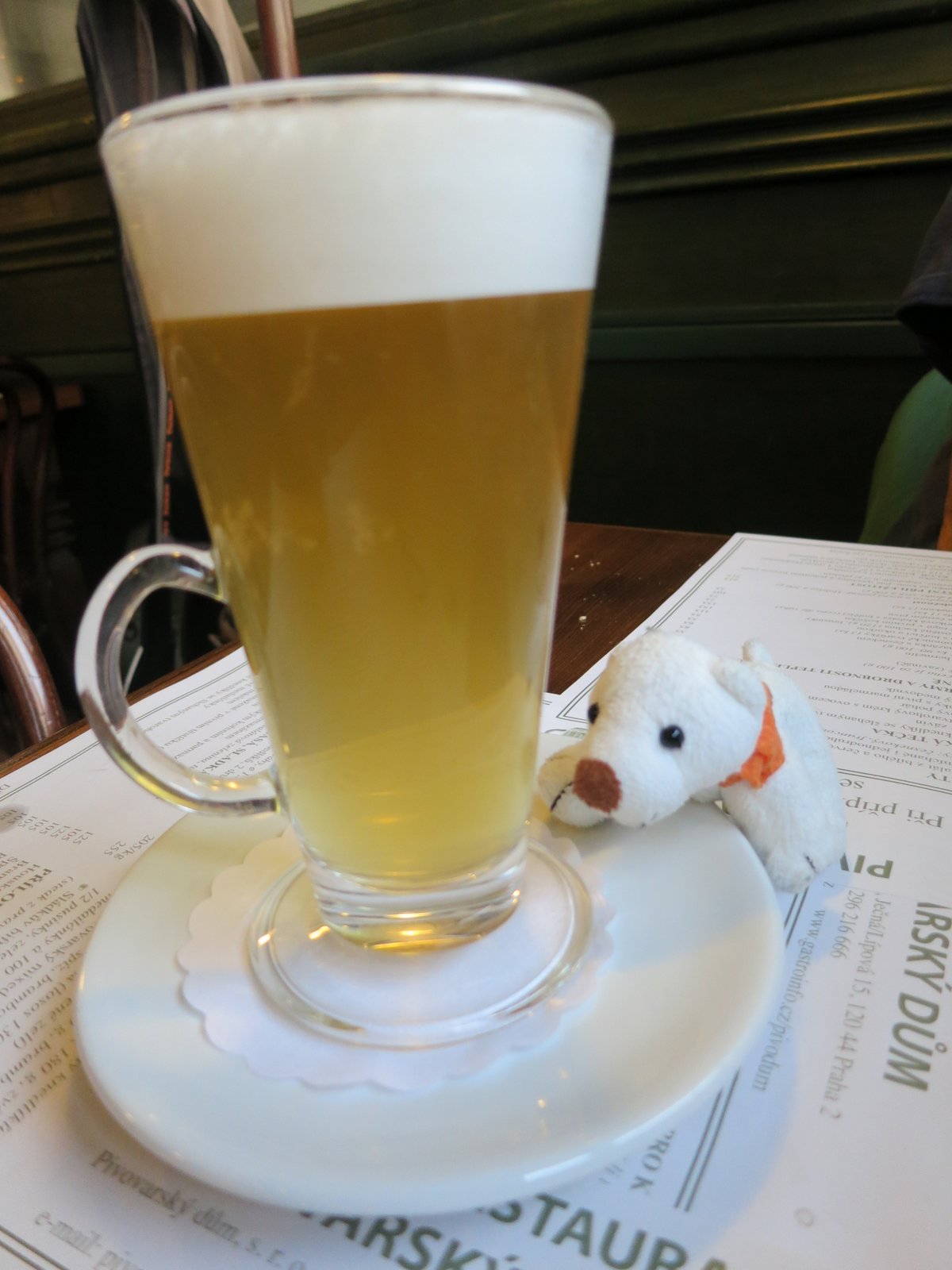

It does actually taste of beer a bit, despite the head being more like the head of a coffee, which doesn't actually disappear... a novel idea, although I can't see it catching on.


Three more Czech attempts at something different: a smoked beer, a stout, and a porter.
The smoked beer, from Cesky Krumlov brewer Eggenberg, was a decent beer but had far less of a smoked flavour than the Franconian versions; some would say that that's a good thing. The 'Primator' stout was also a perfectly good stab, although not particularly distinctive.
I approached the Pardubický Porter with extreme trepidation; the German 'porters' are the vilest thing you will ever taste. Imagine my surprise, and utter joy, to find that it is an absolutely rip-roaring porter, full of the plums, damsons and fig type stuff, and bursting with flavour. Wow.


After a month in Czech, I can say without a smidgen of doubt that Czech beer urinates on German beer from a great height. Not only are the bog standard pasteurised and filtered Czech beers far, far superior to their German counterparts, the wide availability of non-pasteurised and especially unfiltered beers means that a re-run of the Euro 96 final, but played with beer instead of football, would result in an 18-0 thrashing in favour of the Czechs.

Sunday, 21 April 2013

Non-natives

It's usually a good idea when in a certain country, to drink the beer styles which have a heritage there. So avoid lager in the UK which is normally fizzy piss, and don't even get me started on the vile noxious filth which passes for 'porter' in Germany.
How does Czech fare when it comes to brewing non-lagers?


This brewpub "Klášterní pivovar Strahov" in Prague proudly displays its wares.

Non-lager styles are usually referred to as 'special' on Czech menus but without much more detail, whereas in this place they've got a heavy tourist custom.


Come on in...


Their IPA is a regular feature of the show, with various rotating beers, one of which was an 'American Pale Ale'. Everything's unfiltered and unpasteurised naturellement.


The 'APA' on the right contains what the brewery claims are newly breeded hops - 'Mandarin' and 'Polaris', although it doesn't say how the names were chosen. It had been a while since I'd had a heavily citrus hopped beer, and this one reminded me why - all hops and no chops you might say. The bitterness drowned out everything like an enraged elephant in a glockenspiel performance.
The IPA was far better though, with the Amarillo and Cascade in proper proportion. Either of these could have come straight from an American craft brewer.
 

This pair of fellas from a supermarket were a curiosity. I wasn't able to find much detail out about them other than that they're called 'Master Pivo', and that they're 'Special' beer. The lighter one was vaguely like Old Speckled Hen, whereas the dark one looked, smelt, and tasted like a coffee infused stout. Definitely worth getting again, although they're battling for room in my trolley with the unfiltered Staropramen and the unpasteurised Klaster lezak.


Olomouc is a town in the east of Czech, and in the 'Sherlock Holmes' you can find various special beers such as, depending on the season, fruit ales and pale ales.
The pale ale was a commendable effort, and mercifully not overhopped.


Nice as it was, it couldn't quite compete with the star of the show, the unfiltered Rychtar:


Skilful though the Czechs are at brewing non-lagers when they put their minds to it, I'm going to stick with gems such as this.

Monday, 15 April 2013

Nepasterizované

"Tankové pivo" are unpasteurised beers with natural carbonation, delivered to the pub in giant lorries. You can find them in lots of places around Prague, this splendid place being one of them:


Pilsner Urquell, in its bottled form, is a reasonable enough beer, and is the pilsner I'd always drink in Germany if I had a choice. In its 'Tankové' form though it's far superior.


Guz daaan griiiiirt.
So which of pasteurising and filtering is it more important not to do? To investigate I proceeded somewhere which has both unpasteurised and unfiltered beers.


This place has beers from some of the finest breweries in Czech, including Rychtář.


This unfiltered specimen from "únětický pivovar" was unspeakably good. You could guzzle it down in 5 seconds so smooth is the carbonation.
 

Next up was an unpasteurised "Klášter Ležák".


Good but not a patch on the "únětický".
Every time in a Czech pub now I ask for a "nefiltrované" as to me that's more important than "nepasterizované", and sometimes they even understand what I'm saying. Luckily the beer boards outside usually alert you to the presence of such a brew.

Monday, 8 April 2013

UNESCO Lager

UNESCO like to go around slapping their name onto olde stuff to try to persuade people not to knock it all down and build a supermarket instead. Cesky Krumlov is one of its boys.


Could they do the same with lager? Any region, town or city which still makes lager as it's supposed to be made, unfiltered, unpasteurised and with sufficient lagering time, could have a 'UNESCO Lager Area' designation. Franconia in Germany could certainly claim it, and so could here thanks to these Eggenberg geezers:


The light version is unfiltered and better than the dark one. I pondered whether, if you substituted somebody's pint of Fosters for this, would they send it back because it tasted of something?


Some places around town make a real do of ye olde Czech type stuff and serve it up in ye olden style mugs.


Combined with a roaring fire it almost makes you want to not have a bath for a year whilst catching some disgusting skin disease or whatever people did back then.


Rest ye merry, Eggenberg lager and Cesky Crumlov.

Thursday, 4 April 2013

Nefiltrovany

Filtering and pasteurising is of course the worst thing you can do to a beer, so when I spotted this fella in the supermarket I bung a couple in, as you don't have to speak Czech to work out what 'Nefiltrovany' might mean.


The bog standard Staropramen which I tried was very uninspiring; the only one of the ten or so Czech beers I've tried from the supermarket which I wouldn't get again.
This one was way, way, better though; nice and cloudy, with spices and fruitiness. Why exactly would they make the crud ones when they can make this? At about 60 Euro cents I bought another 6 today.


It's always encouraging when a pub / restaurant has brewing equipment on display in the window, and when the menu is headed 'we serve unfiltered and unpasteurised beers' then that's even better.


I went for the mixture of pale and dark lager and it was a reminder that lager can be as flavoursome as any beer when it isn't buggered with.


Lager is the beer equivalent of pizza; abused, defiled, misrepresented and misunderstood.
There's lots of beery snacks to keep you going, such as 'beer cheese'.


They also do their own fruit beers; I went for a 'nettle' and a 'sour cherry'.


The nettle one had just the right combination of beer and fruit flavour; the sour cherry one was much more oriented to the sour cherry taste but was still worth drinking. You even get a real sour cherry at the bottom...


Pivovarsky Dum, may your beer stay nefiltrovany.

Tuesday, 2 April 2013

Krivoklat - castle and beer

What to do with a castle in the 21st century? There are no barbarian hordes to hide from, so instead the unanimous opinion is that the best thing to do with them is to fill them with gippos selling tat.


However, amongst the tat you can find the odd diamond, like this stall, which was doing a brisk business.


And no wonder, when your produce is such as this...


Here's the menu...


I went for a Winterbock seeing as a) it was winter, except it was supposed to be spring, and b) it was the only one that I could understand. You can either get a glass from the barrel, or take a bottle away, or both, which is by far the best option.


Splendidly spicy and warming on a cold winter night, or a cold spring night, with an awesome golden glow.


Pivovar Matuska, splendid fellows all round.

Saturday, 30 March 2013

Prague Supermarket Beers

Is Czech beer more interesting than German beer? I intend to find out.
Perusing the beer section of a Prague supermarket, I noticed that, as well as the Czech brands well known outside the country, there were countless brews I'd not heard of as well. They are also all pretty cheap, around 60 cents a shout, so I grabbed some at random and dragged them back to the batcave.


Kozel was slightly malty, with a gentle kick to it, whereas Breznak was darker, much more malty, with a bigger kick.


Branik was pale and at first taste seemed run-of-the-mill, but grew on me the further down the glass I got. Bernard had a giant head on it, slightly sweet, but very distinctive.


Radegast was a decent brew, easy quaffing - whether it was named after the wizard though I don't know.
So far all the beers were recognisably superior to the vast majority of German beers I've tried - although nothing to write home about, they were all beers I could quite happily drink regularly. However I'd also chucked a Staropramen into my trolley, so that I could do an 'unknown brand vs international brand test'. Switching to this from the Radegast instantly showed the Staropramen up as utterly tasteless and bland, pretty much like a Helles.
In future I'll stick to what I don't know.


Sunday, 24 March 2013

Asahigate


We're all familiar with the idea that, with big name 'international' beer brands, there is little relationship between the beer itself and the brand name - 'Carlsberg' and 'Heineken' are just names slapped on to any locally made piss. The extent to which beers with a certain brand name are consistent varies; of course 'Guinness' is always going to be a stout, but the recipe and quality will vary enormously depending on whether you're in Dublin, Frankfurt, Kuala Lumpr or Addis Ababa.
When such beers arrived in the UK, and the beer drinking public cottoned on to the fact that the fancy Eurolager that they thought they were drinking was actually brewed in Bishops Stortford, then there were many advertising campaigns for the real imported ones which went out of their way to stress the origin of the beer - 'brewed in Bremen... Germany' etc.
So if you want to be sure that the beer you are drinking is the genuine one from the beer's country of origin, what do you look for? You might familiarise yourself with the original design of the bottle label, or you might look for something saying it was an imported one, as batches of the beer destined for export might have an appropriate label to draw your attention to this.
For example, if you saw this:


then you might, not unreasonably, believe that this beer had been imported from Japan. If, on the supermarket shelves, you also saw this:


Then this might well confirm it.
Unfortunately that would not be the case. Imported it may be, but the country of origin is China, not Japan. Closer examination of the back of the bottle reveals:


Yep.... it's brewed under 'supervision of'' Asahi of Tokyo... in fact, Asahi in this form in Hong Kong is made at the same brewery as the local Carlsberg, in China.
As for the label in the supermarket, claiming it is 'imported from Japan'? Lies.
Consumer protection law isn't big in Hong Kong. A flat here may be advertised as being 50 square metres, but that area will include the area of the shared lift and corridor outside... claiming a beer is imported from Japan instead of China is small beer.

Thursday, 14 March 2013

Hong Kong beer bars

Hong Kong has quite a few beer bars dotted around town - the problem is they're all the same. The names are different but there the similarity starts; they're all part of the same chain with the same beers and menus.
Some comedian thought it would be amusing to divide the menu up into "boring beers" and "interesting beers".


At least it used to say "interesting beers" the last time I was here 5 years ago - now it's changed to "Exciting Micro-Imports", which both loses the effect, and is totally inaccurate. Fulller's, for example, are probably both delighted and disturbed to discover that they are in fact a micro-brewery.


Yes, a Grimbergen is considered an exciting micro-import, so even Inbev are a micro-brewery according to these beer gurus.
You might expect that a chain of bars that makes a big deal about having exciting micro-imports might just have some sort of clue about arcane concepts such as the optimum temperature to serve different styles of beer, but no, everything's served at meat-locker temperatures, so the exciting micro-brew you ordered might end up being not that distinguishable from a boring beer. Next time I'll try a red wine and see if it gets the same treatment.


This would have probably been a fine beer had it been put in a sauna for 20 minutes. There are large bowls of nuts forced on you constantly, the shells of which you are encouraged to chuck on the floor in an utterly hedonistic manner; the nuts themselves help to disguise any taste the beer might have had had it not been too cold in the first place.
The most well known of these is on Causeway Bay on Hong Kong island, and is nowadays named "Inn Side Out". This is immensely popular with local office workers at both lunchtime and evenings; rarely for Hong Kong you can "al fresco", if you don't mind queuing for one of the outside tables; inside it's easier to get a seat.
"Slim's" is another branch closer to the financial district. The pale ale they had on tap was splendid, and almost exciting.


On the south side of Hong Kong island is a tacky foreigner enclave called Stanley, where on the seafront can be found the small "Vern's beach bar". This makes a fairly feeble attempt to convince you that you are in Honolulu.
As in all of these bars, you won't hear much Cantonese spoken. In this branch, though, you will overhear many conversations taking the following form:

- "And I was like..... and she was like....."
- "Noooooo!!!!!......."
- "And she was like.... and they were like.... and I was like....."
- "Oh m'gaaaaaad.... like Daaaaaaaaahhhhhh!!!!!"

There is in fact massive scope for devising drinking games whilst listening to such conversations, an exercise which I leave for the reader (Shane Watson - did you hear that?).

Thursday, 7 March 2013

Korafuto Biiru


Germany taught both China and Japan to brew beer. In the case of China the diktat about all-malt didn't last long - the vast majority of beer from China is practically undrinkable piss, although it's cheap ("Portillo's wife defends crack habit").
In the case of Japan, though, the German influence still remains. All the major Japanese brewers continue to brew all-malt beers, and furthermore Japan is dotted with German style brewpubs, some even going as far as to dress the waitresses in Bavarian outfits. Unfortunately they seem to also have inherited the German penchant for fairly bland beers, and a restrictive conservatism - none of the main Japanese brews like Kirin, Asahi or Sapporo are particularly interesting.
They're very widely available in Hong Kong supermarkets and convenience shops though, and seeing as they're scarcely more expensive than the locally brewed adjunct ridden stuff, I might pop a few Kirins in the trolley sometimes to drink with dinner or something. Whilst in the foreigner oriented supermarket in Hong Kong's financial district though, I spotted some beers from Japan's nascent craft brewing scene.


First up was this stout from Echigo, "Japan's first micro-brewery". On the rear of the can there's an outline picture of a geezer playing a saxophone, so I imagine Echigo thought that you would sip this whilst in a jazz bar or something. The can also tells you that it's "high quality premium beer", which I think is blowing its own saxophone a bit. The beer itself was very good though, with a decent coffee after-taste. Reminded me of Sierra Nevada's stout. Niiiiice.


From the same brewery comes "Weizen", which on the reverse of the can tells us it's a "White Ale". There's a picture of what I presume is a Bock on the front, which was a bit confusing, and on the back there's a picture of a Bavarian-outfitted couple toasting each other. There's also a slogan exhorting us to "Craft Beer The World", which confused me even more.
Upon popping the can, I was greeted with a smell which made me think of a fizzy drink, an impression which wasn't diminished in any way when I tasted it. It didn't really remind me of either a German Weissbier or a Belgian Witbier - there was far too much carbonation. If Echigo are really attempting to craft beer the world they should probably try it with their stout.
They also make a red ale, not pictured, which was very decent. So as the famous piece of lard 'Meat Loaf' once told us, 2 out of 3 ain't bad for Echigo.


The prize for the most interesting bottle goes to "Ginga Kogen Beer", although at one point it was almost mistaken for a bottle of Chinese medicine, which would have been a shame. According to their website, their beer "delivers the charm of the beer based on German traditional technology." That may well be, but this particular one, "Silver Bottle" to me was  much closer to a Belgian Witbier than a German Weissbier, and was the pick of the four. Banzai.